
Determine why components fail, assess remaining service life, and make informed repair or replacement decisions with Liburdi's engineering and metallurgical expertise.


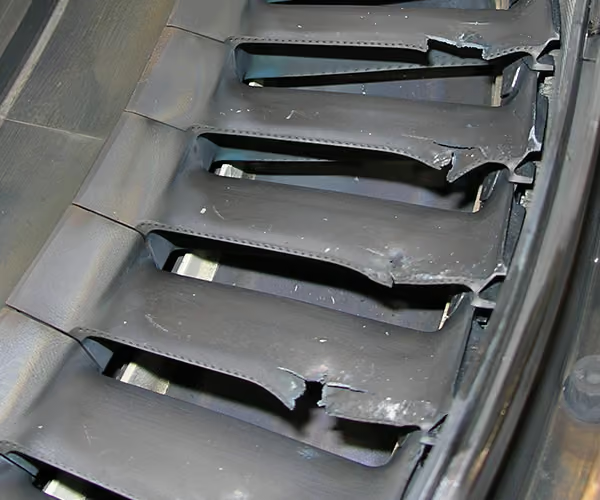
Unexpected gas turbine failures can trigger unplanned outages, costly repairs, lost revenue, and difficult maintenance decisions.
Just as importantly, components are often removed from service without a clear understanding of how much usable life remains.
Without understanding the root cause of damage or the remaining life of affected components, operators may replace serviceable hardware too early, return damaged components to service, or experience repeat failures that drive additional downtime and maintenance costs.
Liburdi's engineering and metallurgical team helps operators identify root causes, assess remaining service life, and support informed repair, replacement, and maintenance decisions through failure analysis and life assessment.

Identify root causes and contributing factors to help reduce the risk of recurring component damage.

Assess remaining component life to support informed repair, maintenance, and replacement planning.

Apply decades of gas turbine expertise to put damage into the proper operational context.
Many laboratories can identify the failure mechanism of a damaged component. Few can place that damage within the broader context of gas turbine operation, repair history, and long-term reliability.
Liburdi combines engineering, metallurgy, and decades of gas turbine repair experience to move beyond simply identifying failures. By comparing components against historical evaluations, known damage mechanisms, and previous case studies, our team helps operators understand why a failure occurred, what factors contributed to it, and what actions can help prevent it from happening again.
The result is practical, turbine-specific recommendations that support more informed repair, replacement, and maintenance decisions.

Understanding why a component failed or how much life remains starts with understanding the material itself.
By evaluating creep damage, fatigue, thermal aging, and other microstructural changes, Liburdi's engineering and metallurgical team helps operators assess repairability, estimate remaining service life, and make informed maintenance decisions.
Liburdi engineers have contributed to ASM Handbook chapters focused on gas turbine failure analysis and component life assessment.
Finite element stress analysis helps evaluate component loading, predict remaining life, and support informed maintenance decisions.
Combined with metallurgical evaluation and failure analysis, Liburdi's engineering approach provides practical recommendations that help operators reduce risk and maximize component life.

For the same reasons that it’s wise to get a regular check up with your doctor, a life analysis is an evidence-based approach to determination of:
Typically, only a single part is required for destructive testing; a blade which has irreparable damage can be selected to avoid destruction of another wise repairable blade. Analysis of additional blades may be necessary if a blade set has a multiple populations, but only if the populations of a similar vintage – analysis of the oldest blade group can often suffice.
Turbine disks operate at temperatures below which metallurgical degradation is evident. Cracks can develop over time, however, so determining safe operating intervals beyond OEM life limits requires determination of the disks operating conditions (stress and temperature) through finite element analysis (FEA) and estimations of cracks growth rates under these conditions, using the principals of fracture mechanics. Safe operating intervals can then be established, based on the expected time for cracks to grow from a detectable size to a critical size.
Yes. Failure analysis helps identify the factors that contributed to a component failure, allowing operators to make informed repair, maintenance, and operational decisions that reduce the likelihood of similar failures occurring again.
Liburdi performs failure analysis and life assessment on a wide range of hot gas path and rotating components, including blades, vanes, discs, combustor hardware, and other critical gas turbine components.